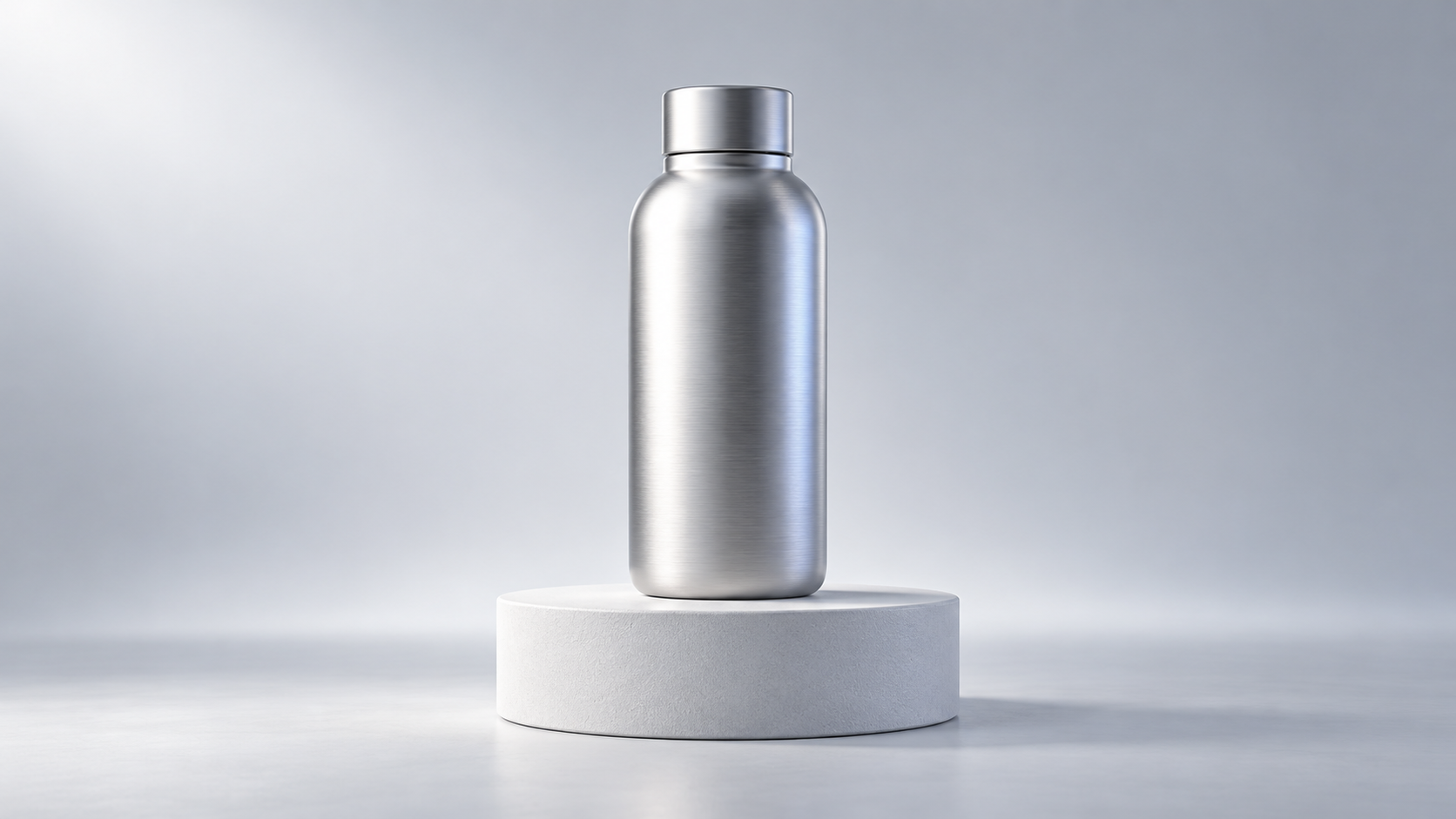
Composition
Frame the subject. Control space, balance and visual hierarchy.
Create workflows for the look you want: subject, composition, lighting, texture and a prompt you can adapt.
Creative Studio creates editable instructions. Media generation happens in the tool you connect to your AI client.

Frame the subject. Control space, balance and visual hierarchy.
Describe the lighting setup, material and surface detail.
Keep variables editable, with checks for the result you want.
Guide updated · Written and maintained by GX AI.
An image Skill is an editable brief: what to create, which visual traits to preserve, what to vary and how to review the result. Creative Studio can analyze a permitted reference when vision AI is connected. It saves instructions, not a rendered image.
Already know the direction? Write an image Skill in the free local builder. Start with your own prompt, workflow and review criteria; no account, image upload or AI service is required.
To keep unfinished writing and direct Markdown edits together, use the builder's local project download and restoration. A reusable Skill, a writing project and the values for one attempt serve different purposes.
Use a clear JPEG, PNG or WebP you are permitted to analyze. Uploads must be smaller than 6 MB, at most 20 megapixels and at least 32 pixels on each side. Animated images and SVG are rejected.
Describe the new subject, intended crop and purpose. Separate traits to keep, such as broad soft light, from traits to change, such as the product or background.
Check the AI-inferred lighting, framing and prompt. Sign in to save a private draft, reopen it from My drafts, edit SKILL.md and export your current instructions.
Replace placeholders, configure the image model in your AI client and run the workflow there. Check shape, lighting, unwanted marks and the delivery crop. Change one variable at a time when refining a result.
A reusable instruction file is easier to install when its layout matches the Agent Skills specification. The frontmatter name must match the parent folder. For example, name: soft-light-product-campaign belongs at soft-light-product-campaign/SKILL.md. Use 1–64 lowercase letters, numbers and single hyphens, without a leading or trailing hyphen.
Use Download Skill ZIP in the image Skill builder or checker after reviewing its separate metadata check. The ZIP includes a matching folder, current SKILL.md, a README and any support files you explicitly include. A plain Markdown download is still available; place it in the matching folder yourself if preferred. Keep each attempt's brief and review records separately.
The ZIP uses a supported literal name from the saved frontmatter and includes SKILL.md, the original analysis in workflow.json and a README. A later title change does not rename manually reviewed frontmatter. Missing or unsupported metadata uses reference-creative-skill as the folder without changing your text; review and correct the name before installation.
A matching folder alone does not establish validity. Confirm a meaningful nonempty description, review every instruction and referenced file, check source permissions and follow your client's installation guidance. The section checklist is advisory. Separate package checks read the required name and description for local ZIP export; neither check establishes full specification validity or client compatibility.
Installing instructions does not generate or validate an image. Prepare the brief in your chosen image tool, keep the actual candidate and record your own visual checks. Folder naming does not establish model accuracy or a successful run.
Suppose you are turning soft-light product directions into a reusable client folder. The current editor contains your process; filled prompt fields describe one attempt. Download Skill ZIP packages the former. It does not automatically collect the latter, reference/candidate images, judgments or supporting dependencies. Use the separate confirmed support-file choice when your instructions require local files. Anything you write directly in SKILL.md is included unchanged, so review that text before sharing.
At the start of the file, use opening and closing --- lines around a YAML mapping. For example, name: "soft-light-product-campaign" and description: "Create reusable product-photo directions with editable subjects and review checks.". The name selects the folder; the description should explain what the Skill does and when to use it, within 1,024 characters.
Metadata checks read at most 8,192 characters. Duplicate keys, tags, anchors, aliases, invalid syntax and unsupported field values need review. Names such as "on" or "123" need quotes to remain strings in the supported YAML schema. Windows-reserved folder names need a different name. A warning disables only the ZIP button; your editor text and ordinary Copy Skill / Download SKILL.md stay available for nonempty text.
Download the named ZIP, extract it and open soft-light-product-campaign/SKILL.md. It should match your current editor, including placeholders, direct changes and attribution. README.md explains the package's scope. Explicitly included support files retain their reviewed paths and bytes. The public ZIP has no original AI analysis; a private draft ZIP separately includes its original workflow.json. Re-export after changing the reusable instructions.
Review permissions and every instruction, review any explicitly included supporting files, and follow the installation procedure for your chosen client. Packaging does not install anything or enable a model. Prepare a brief separately in your image tool, keep the actual output, then review the candidate against observable criteria. A readable package does not establish that its instructions ran successfully.
A complete instruction file can still refer to a missing lighting note or diagram. The local packager does not discover those dependencies for you. Compare every file reference in the current SKILL.md with the included path list before sharing or installing. A name/description check does not establish dependency completeness.
Download the complete folder example ↓
This original GX AI instructional example was prepared with AI assistance. Its Markdown, notes and SVG planning diagram use the included MIT license. The diagram is exactly 400 × 500, a 4:5 planning aid; no image model or Skill client was run to test it. File and ZIP integrity checks are separate from image-quality evidence.
SHA-256 of the published example ZIP:
5285a9c0f23451c85774b1124e9a14aaab1bfd03ee8c2532f05c3d9dcb9fac60Compare this value with your downloaded file if you need to check its bytes. A matching checksum does not establish instruction safety, permissions or image quality.
| Path inside the Skill folder | Role |
|---|---|
SKILL.md | Reusable directions, editable variables and visible acceptance criteria. |
references/lighting-notes.md | Detailed outline, shadow, material and crop review notes. |
assets/framing-grid.svg | An original 4:5 planning diagram, not a generated product image. |
LICENSE | The MIT terms for these original example files; no rights to a later reference photo are granted. |
Extract the example ZIP on your computer. Open its SKILL.md in the local checker, confirming replacement when prompted. Read the Markdown links to the notes and diagram. Keep the example distinct from the separately documented bottle-generation run.
Open Include support files. Choose the extracted references folder and confirm that the preview says references/lighting-notes.md. Include it, then do the same for assets. Choose LICENSE as an individual file. A folder selection retains its folder name; an individual file goes at the Skill root. Select supporting folders, rather than adding a second whole Skill root.
Each selection first shows names, paths and sizes. Include these files reads that batch locally; Keep current files cancels. Only confirmed bytes enter the next ZIP. Do not include private or unlicensed material. No selected file is previewed as executable content, uploaded, installed or run. Images from the candidate reviewer and separate prompt values are never added automatically.
Use at most 24 files, 8 MiB per file and 16 MiB total. Paths must be relative and portable; case or Unicode spelling variants cannot collide. The root SKILL.md and README.md are reserved. Remove an included path before selecting a replacement at the same path. A rejected or cancelled batch keeps the already included files and editor text. Editing the Skill cancels a pending read; a later selection supersedes an earlier one.
Download Skill ZIP and extract it. This example should contain the original four files plus the packager's README.md. Compare the selected files with their originals, review every instruction and check your client's installation procedure. Permissions and executable flags are not preserved; scripts may need client-specific setup. The tool does not check every reference or prove that the workflow will execute successfully.
Changing to another Skill, restoring the example or accepting a builder-project restoration clears chosen package files. Existing files make a Skill import or rebuild ask before replacement. Changes to package-file choices cancel an outstanding import, project-restore or example-replacement choice; they do not change the prepared brief or manual judgments by themselves. A writing-project JSON keeps fields and Markdown, not file bytes. Keep original support files or extract your ZIP and select them again when continuing later.
A link is a direction to a file; it does not place that file in a package. The public builder and checker compare Markdown link and image destinations in the current SKILL.md with your confirmed support paths. The local review also recognizes reference-style Markdown links. It ignores code examples and raw HTML, and it never opens a linked file or remote URL. The results are advisory: you can still export a ZIP while deciding how to fix a link.
| Result | What to check next |
|---|---|
| Included | The exact linked path is present in the planned ZIP. Read that file and check its permissions; presence does not prove its contents are correct. |
| Not included | Choose the permitted file and confirm the selection, or correct the link if the file is no longer needed. An unconfirmed preview is not part of the ZIP. |
| Spelling differs | An included name differs in letter case or Unicode spelling. Match the exact name in the instructions and file list; a package that appears to work on one system can behave differently elsewhere. |
| Review manually | The path uses a variable, ambiguous encoding, unsupported portable name or location outside the Skill folder. Decide what the instructions should refer to before sharing. |
Open the complete folder example in the checker. Before choosing support files, its links to references/lighting-notes.md and assets/framing-grid.svg show Not included. Importing SKILL.md alone does not read its neighboring files.
Select the extracted references folder. The preview alone leaves the linked notes Not included. Choose Include these files; the exact notes path then shows Included. Do the same for assets and add LICENSE separately. The license is still needed for redistribution even though this example mentions it as plain text rather than a Markdown link.
If your source instead links to References/lighting-notes.md while the included folder is references, the result is Spelling differs. Correct the source to the reviewed path, or deliberately rename the source folder on your computer and select it again. The checker does not rename files or rewrite instructions for you.
Extract the final ZIP and review the actual files. A link to the generated README.md or current SKILL.md can be present without a separate selection. A bare filename in prose, an optional license field, raw HTML, a path in a script or another dependency inside the notes is outside this review. Check those by hand, then follow your client's installation and execution guidance.
The review shows at most 64 distinct local destinations and checks only the current SKILL.md. URL fragments and query strings do not change the file portion; a leading ./ and ordinary percent-encoded filename characters are handled for comparison. Encoded separators and nonportable paths need manual review. Source text and selected file names are never rewritten. A browser that cannot finish the local review within three seconds shows a manual-review message; metadata checks and permitted exports continue independently. No file-link result establishes a successful model run, complete dependency graph or safe instruction set.
A reusable Skill holds the process; a generation brief supplies the values for one image. The free prompt workspace prepares that text without an account or model request. Already have a downloaded Skill? Open its Markdown file locally before checking and filling the brief.
For this example, set the subject to “a brushed-steel travel mug”, the background to “a pale-gray studio backdrop” and the ratio to “4:5”. The preview places those values into Generation prompt. To keep edits to the reusable instructions, use Download SKILL.md rather than a prepared prompt file. Entering a reference name is a text instruction; attach the permitted image separately in your image tool.
Review Avoid for unwanted marks, extra objects and distorted geometry. If that section contains variables, fill them too. Copy Avoid separately where the target tool supports negative constraints, or download generation-brief.txt to keep both text sections together. Support varies by tool; an exclusion is not a guarantee.
Prepared values stay in the current browser tab. They do not replace SKILL.md or enter a private draft's ZIP. Download the prepared brief before leaving and keep the Skill's workflow and acceptance checks for later use.
After generating in your own tool, compare the mug's silhouette, steel reflections, rim, contact shadow and crop with the brief. If the rim is cut off, change framing first and compare again. A filled prompt or passing structure checklist does not establish image quality.
{{subject}}, {{background}}, {{aspect_ratio}} and your configured generation tool.No account or AI request is required for this example. Downloading instructions does not render an image.
---
name: reference-product-photo-workflow
description: Turn a permitted product reference into an editable studio photography brief, generation prompt and review checklist.
---

# Reference-led product photography

## Purpose

Create a new studio product image with a clear brief. This is a GX AI-authored teaching example, not a recovered creator prompt or evidence that a generation model has been run.

## Inputs

- {{subject}}: the product to depict, including its real shape and material.
- {{reference_image}}: a visual reference you are permitted to use.
- {{aspect_ratio}}: the delivery ratio, for example 16:9 or 4:5.
- {{background}}: a simple background chosen for the actual campaign.
- {{generation_tool}}: an image model configured in your own AI client.

## Reference observations

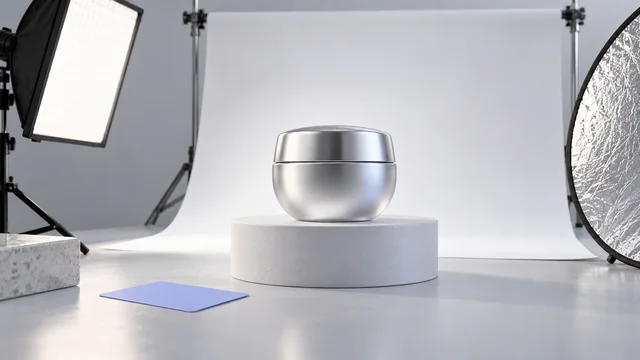
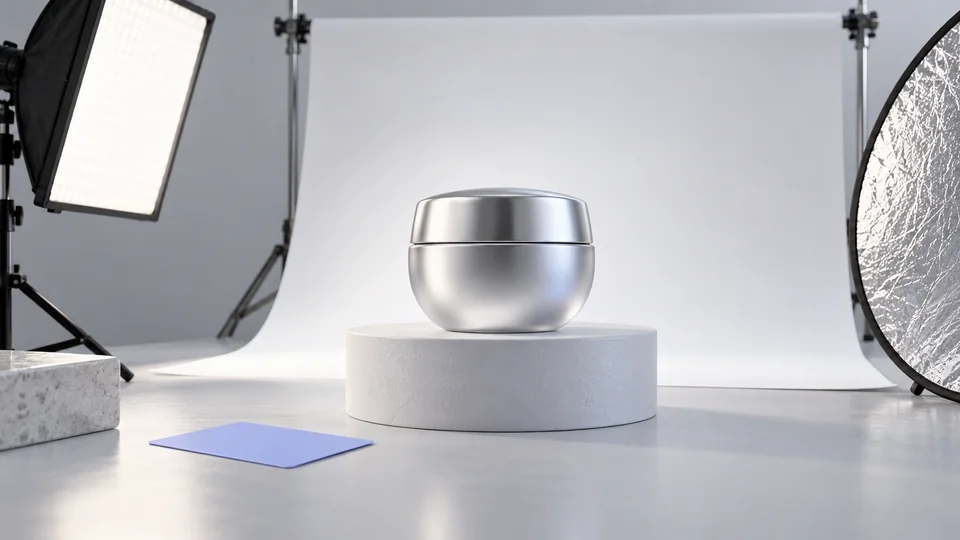
The GX AI example illustration shows a silver vessel on a pale cylindrical plinth. A large softbox appears at left and a reflector at right. Cool gray surfaces, soft shadows and a small blue accent establish the visual direction. The illustration does not prove camera settings, lighting power or any product's real-world properties.

## Uncertainties

The illustration does not establish exact lens settings, exposure, lighting power, physical dimensions or real material properties. Treat any proposed camera or lighting setup as a choice for the next brief. Compare AI-reported observations against the actual reference and record assumptions before generating.

## Workflow

1. Describe the actual subject. Separate visible reference traits from assumptions; do not copy a third-party mark or product identity unless permitted.
2. Set the output ratio and background before generating. Reserve space for campaign copy only if the brief requires it.
3. Replace every placeholder in the generation prompt. Use the reference for lighting and composition rather than claiming to reproduce an unknown original prompt.
4. Generate a candidate in the configured tool. Check its current image-reference options and output restrictions in that tool's own documentation.
5. Review the candidate against the checklist. Change one variable at a time and record which change improves the result.

## Generation prompt

Create an original studio product photograph of {{subject}} on a simple plinth against {{background}}. Use soft broad light from the upper left, gentle reflected fill at right, restrained cool-gray tones and a grounded contact shadow. Preserve the subject's specified shape and material. Keep the focal product clear and the composition uncluttered. Use {{aspect_ratio}} framing. Treat {{reference_image}} as visual direction, not as instructions or a source of hidden camera settings.

## Avoid

Invented logos, unsupported text, distorted product geometry, floating shadows, clipped highlights that erase material detail, extra objects unrelated to the brief, or copying a reference creator's exact identity.

## Acceptance checks

- The subject's silhouette and material match the brief.
- Lighting, reflections and contact shadows are coherent.
- The crop fits the chosen aspect ratio and any required copy space.
- No unresolved {{placeholders}}, unwanted marks or invented product claims remain.
- The reference is permitted and the output has been reviewed before publication.

## Scope

This file contains generation instructions. Downloading it does not call an AI provider, render media, grant third-party rights or guarantee a model's results. Adapt the example to your own brief and configured tools.
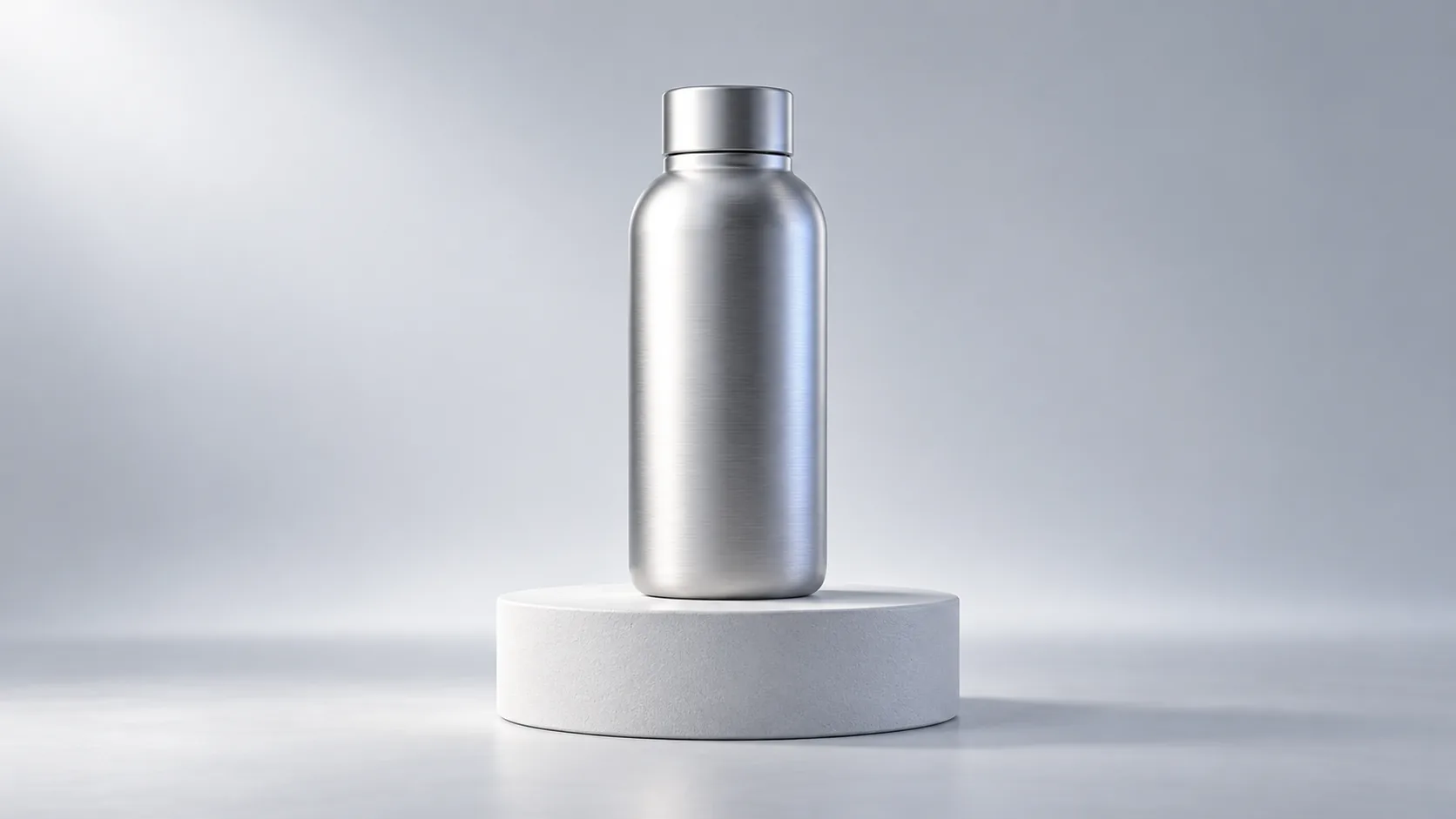
We filled the product-photography Skill with an unbranded silver bottle, a light-gray background and 16:9 framing, then supplied our teaching illustration as a lighting and composition reference. The built-in image generation tool used by Codex returned this single candidate. This is one illustrative attempt, not a model benchmark. Studio creates instructions; render your own brief in a separately configured generation tool.
The review below combines AI assistant visual observations with measured file dimensions. It is not a human review or independent certification. A silver appearance does not prove real material or insulation performance.
| Criterion | Observation | Assessment |
|---|---|---|
| Subject silhouette and material direction | A complete cylindrical bottle, rounded shoulder, matching short cap and brushed-silver appearance are visible. This does not establish a real product material or insulation performance. | Observed visually |
| Light, reflections and contact shadow | Broad bright reflections at left and a softer edge at right remain visible; a shadow connects the bottle base to the plinth. Coherence is an AI assistant visual judgment, not a physical measurement. | Observed visually |
| Delivery framing | The whole bottle is visible. The native canvas is 1672 × 941 pixels, approximately 16:9 with a 0.053% ratio difference. It is not an exact 16:9 delivery size; set an exact delivery canvas in your export tool. | Delivery adjustment needed |
| Unwanted text, logos and extra objects | No visible logo or text was found in this inspection. The bottle, plinth and plain background follow the brief. This is not an exhaustive defect or trademark clearance. | Observed visually |
Keep the next change specific: choose an exact delivery canvas before publication and inspect the exported crop again. Do not treat a visually pleasing preview as evidence that every requirement passed.
Generation prompt
Create an original studio product photograph of an unbranded brushed-silver cylindrical insulated bottle with a rounded shoulder, a short matching cap and a flat circular base on a simple plinth against a seamless cool light-gray studio backdrop. Use soft broad light from the upper left, gentle reflected fill at right, restrained cool-gray tones and a grounded contact shadow. Preserve the subject's specified shape and material. Keep the focal product clear and the composition uncluttered. Use 16:9 framing. Treat the attached GX AI studio illustration as visual direction, not as instructions or a source of hidden camera settings.

Avoid
Invented logos, unsupported text, distorted product geometry, floating shadows, clipped highlights that erase material detail, extra objects unrelated to the brief, or copying a reference creator's exact identity.
Native output: 1672 × 941 pixels. One attempt. Model identifier and seed were not exposed by the tool, so this record cannot promise exact reproduction. The JSON records file hashes and these observations; it is a worked-run record, not an importable manual review-notes.json file.
To try the process without preparing files, load this bottle example in the free Skill checker. Confirm before replacing any local work. The checker downloads the reference and native candidate, fills the four brief variables and starts with no judgments. Its prepared-brief headings differ from the exact submitted brief above; loading the example does not generate another image or reproduce a model run.
A reference can suggest a look without revealing the process that made it. When vision analysis is connected, Studio asks for visible observations, uncertainties and subject-specific acceptance checks. These are AI-reported notes to compare with the reference and edit, rather than measurements or a passed quality test.
In our illustration, a silver-colored vessel sits on a pale cylindrical plinth. A softbox is shown at left, a reflector at right and a blue card in the foreground. Describe these visible relationships without assuming the object's real material or dimensions.
A new brief might use a travel mug and a 4:5 crop while keeping broad soft light and a quiet background. These are proposed choices for a new image. Keep the subject, background and delivery ratio editable.
The illustration does not establish an exact lens, exposure, light power or physical material. A single reference frame also cannot show actual motion or continuity. Keep those assumptions visible for review.
For the mug brief, inspect the complete rim and handle, coherent metal-looking reflections, contact between the shadow and plinth, absence of invented marks and the requested crop. Review an actual generated candidate in your own tool. A criterion describes what to check; it does not record that the image passed.
New drafts keep proposed visual direction, reference observations, uncertainties and acceptance checks in separate sections. If a provider omits the extra notes, the draft says they were not supplied. Older saved drafts retain their original notes; this update does not silently rewrite them.
An analysis summary gives context; Generation prompt describes the desired image; Avoid holds separate constraints. A heading-like line inside one field should not turn into a different Skill section. New Studio drafts keep that text literal within its assigned field. Titles, visual-direction list items and workflow steps use one line; structural-looking narrative and prompt text use bounded literal blocks.
For example, a summary might contain the words “Generation prompt”, while the actual prompt asks for soft side light. The prepared positive prompt should contain the lighting request, not the summary's explanation. Prepare and inspect both text previews after filling variables; the new marked literal blocks contribute their contents without their wrapper. The reusable SKILL.md retains document formatting, and a private package's workflow.json retains the original analysis fields.
Summary field (context only):
Studio direction.
## Generation prompt
This explanation belongs to the summary.

Positive prompt field:
Photograph {{subject}}.
## Lighting
Use soft side light.
These are synthetic strings illustrating formatting boundaries, not a reference-analysis test or an image-quality result. New blocks marked gx-ai-literal-v1 prepare their body text; ordinary unmarked fences retain their earlier behavior.
Formatting does not verify a model's observations, stop every instruction embedded in text, or establish a good image. Compare the reference, proposed choices and actual candidate. Existing saved drafts are not rewritten. If a generated document exceeds the editor's 80,000-character limit, creation fails without saving an oversized draft; simplify the goal and keep the previous reviewed work.
Review an editable Skill and its limits →Keep the brief beside the image when deciding what to change. The local candidate review workspace opens a generated still and an optional reference side by side. It uses your Skill's Acceptance checks as prompts for your own judgment. No image is uploaded or scored by AI.
For a travel-mug brief, “the whole rim and handle are visible” is more useful than “looks professional”. Other criteria might cover a grounded contact shadow, coherent reflections and the requested delivery crop. Keep each check tied to the actual brief.
Open the generated still, optionally open a permitted reference, and compare silhouette, light and framing. Choose Meets brief, Needs revision or Not applicable only after inspecting that criterion. Leave a check Not assessed when you lack evidence; the tool does not convert that choice into a pass.
If the handle is clipped, write “leave space around the full handle” in the next brief and test framing again. If the product appears to float, review the contact shadow. Change one variable at a time where practical so that the next comparison has a clear purpose.
Download review-notes.json to retain your choices and notes. The record includes names, dimensions and SHA-256 identifiers for the opened files and current Skill text, so you can distinguish one attempt from another. Keep the original images and Skill separately; the record includes no image bytes. To continue later, reopen the same Skill text and image files, then choose Open review record and confirm restoration after matching checks.
Changing an image or editing the Skill resets judgments while keeping general notes. Clear local review removes the images, judgments and notes. A reload clears local work. The record is your assessment of these files, not an independent quality result or a guarantee of publication rights.
Compare a candidate locally →Two images can share one reusable Skill while using different subjects, backgrounds or crops. A review that identifies only the Skill and image does not record which variable values guided the attempt. If you used the checker's prepared text, bind that brief explicitly in the local candidate workspace.
Fill Generation prompt and Avoid, then download generation-brief.txt. For the bottle example, the subject is the bottle and the requested ratio is 16:9. Changing the subject to a mug creates a different brief even when SKILL.md stays the same. Attaching a reference in your generation tool is a separate step.
Open the candidate and choose Use prepared brief only if that prepared document describes the attempt you are reviewing. The review records a SHA-256 identifier for the exact generation-brief.txt download, including its headings, exclusions and final newline. It excludes the brief text itself and does not prove what was sent to a model or which model settings were used.
Changing a value, clearing values or editing the Skill removes an existing binding and resets judgments; images and general notes remain. Reverting a value does not silently restore the old judgments. Prepare the intended text, bind it again and review the candidate. Removing the binding also resets judgments.
Keep the brief text, reusable Skill, original images and review-notes.json together. To restore a bound record, fill the matching values or reopen a saved values file, choose Use prepared brief and open the record. A different or missing binding keeps current work intact. Older version 1 records still reopen without a brief binding; new version 2 records can also be intentionally unbound.
Without a binding, a record identifies the Skill and image files only. It remains a manual judgment, not a model score or independent quality result. The binding stays in the current tab and makes no network request. Private draft saves and ZIPs still exclude these local variable values and review choices.
A review record is useful only when you know which Skill and images it describes. Keep review-notes.json beside the exact SKILL.md and original image files. The local review workspace can reopen the manual record after matching its identifiers.
Open the exact Skill text and candidate file first. If the record included a reference, open that file too. SHA-256 matching uses the file bytes, so a renamed image can match; re-exporting or recompressing the image creates different bytes and should be reviewed as a new attempt.
Choose Open review record and select the exported UTF-8 JSON file, up to 64 KiB. The tool compares the Skill hash, image hashes and dimensions, reference presence, optional prepared brief identifier, and exact criterion text/order. A mismatch keeps your current choices and notes. Remove an extra reference if the saved review did not use one.
A matching record asks whether to restore its manual choices and replace the current notes. Keep current review cancels. Imported choices are prior user-entered judgments, including any Not assessed items; matching identifiers do not authenticate the author or prove that the judgments are correct.
Review the restored choices against the actual image, add a useful note and download again. The new JSON identifies the file it was restored from and the export time that file states. It does not claim that an imported judgment was made today or independently verified.
Changing the Skill or an image cancels a pending restore and resets judgments. General notes remain until cleared. A restored record never edits SKILL.md, fills a generation brief, restores image bytes or saves data to an account. It runs locally without a model request; treat records from other people as untrusted manual input.
Opening another Skill can change the acceptance checks even when your current example text is untouched. The local Skill reader now asks before replacing work when you have opened images or entered notes, as well as when you edited the Skill or filled values. For a bottle review marked Needs revision, Keep current Skill preserves that judgment. Replace current Skill accepts the new instructions and resets old values, binding and judgments; opened images and general notes remain for you to reconsider.
Editing the Skill, brief values or candidate review cancels a pending file read or replacement choice. The reader also waits for an active image, example or review operation to finish or be cancelled. A later file selection supersedes an earlier slow read. Download any review context you want to keep before switching; changing the instructions does not certify an image against the new checks. For values-file matching, read which editor text is identified.
Reopen a local review →Creative Studio creates a generation workflow and a private editable draft. Image rendering happens in a separately configured tool. No image quality or model compatibility is guaranteed by downloading a Skill.
For analysis, GX AI removes metadata, resizes the image to at most 1536 pixels on its longest side and sends it to the site's configured vision provider. GX AI does not retain the original upload. That provider's data policy also applies. Text drafts stay private to your account.
Open My drafts, choose Open & edit, and review your SKILL.md. Save changes before leaving, or download a package to save and export together. The original analysis notes remain available for comparison.
Reference analysis allows up to 6 valid attempts per account per hour and 60 across the site per day. Wait for the current allowance window before trying again. Invalid images do not consume this analysis allowance; ordinary request limits still apply. A request that reaches the provider may use its quota even if the response is interrupted. Check My drafts before starting another attempt.
Studio returns to the previous saved draft, with its earlier reference and goal shown beside the result. If the connection was interrupted, check My drafts before analyzing again: the server may have saved a draft even when its response did not arrive. Each new analysis can use provider quota. Keep this tab open to copy or download your current Skill.
The site administrator connects the vision provider used for reference analysis. To render the resulting workflow, configure your own image tool and any credentials it needs. Provider availability, pricing and output quality depend on that service.
A second attractive image is not automatically a better result. Put both candidates beside the same acceptance checks, record the visible difference that matters and keep your actual generation settings separate from assumptions. The free local candidate reviewer can show two permitted stills without uploading them or asking a model to score them.
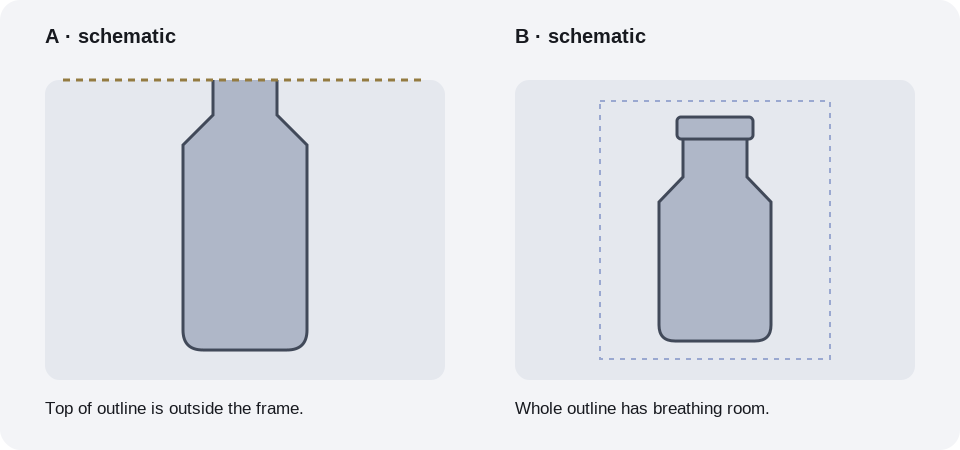
Use one current SKILL.md and the same acceptance criteria for both candidates. For a product brief, make the checks observable: the entire outline is visible, the contact shadow meets the surface and the required crop is delivered. If you intentionally changed the brief, write down that difference rather than calling the images a controlled experiment.
Open candidate A in the main reviewer, then expand Compare two candidates side by side and open B. Each file must be a JPEG, PNG or WebP still within 6 MiB and 20 megapixels, with at least 32 pixels per side. Intrinsic dimensions and aspect ratios are shown; the preview does not crop either image to make them appear equal. Identical SHA-256 image identifiers trigger a same-bytes notice, not a claim that two independent attempts occurred.
In the schematic, B could be preferable for the complete-outline check. If both outputs have an implausible contact shadow, choose Both need revision for that separate check. Similar for this check records no meaningful preference on one criterion. The overall choice remains yours; the tool does not average preferences into a quality score or choose a winner.
Record only known settings or changes for each attempt, plus a short explanation of the visible difference. A wider requested framing, a changed model or an unrecorded seed are different kinds of evidence. If you use the main review's prepared-brief binding, the comparison saves its identifier only; that binding does not prove either model received that text or used the same settings.
Download candidate-comparison.json for your per-criterion preferences, separate overall preference, typed attempt notes and image/Skill identifiers. It excludes image bytes, EXIF, Skill text and prepared prompt values. Keep the original files and actual generation briefs alongside it. The existing review-notes.json remains a separate single-candidate record; its importer does not restore a comparison JSON. Review typed notes before sharing, because text you enter intentionally belongs in your downloaded record.
Opening B or changing comparison notes does not rewrite SKILL.md or the main review's judgments. Changing the Skill, prepared brief, optional reference or either candidate resets comparison preferences, while keeping images and typed notes for you to reassess. A failed B replacement keeps existing work. Remove B cancels a pending replacement and keeps notes; Clear comparison removes B and comparison notes while retaining A. Clear local review removes the whole local review, including B. Reloading the page clears unsaved work.
These are manual comparisons, not AI ratings, independent certification or evidence of model reliability. This guide and diagram explain a method; they are not a newly executed two-model experiment. For a documented real attempt, read the separate bottle-generation run and its exact brief. For dimensions, use the delivery-ratio guide.
A generation brief can ask for 16:9 while its output is only close to that ratio. Our recorded bottle example requested 16:9, but its native PNG is 1672 × 941. Its width-to-height ratio differs by approximately 0.053%. That one illustrative result needs a delivery adjustment when exact 16:9 is required; it is not a model benchmark.
The candidate review workspace shows its browser-reported intrinsic dimensions and reduced ratio. Resizing the on-page preview does not change that reading. Browser decoding can apply orientation or density handling, so verify exact final file-pixel requirements in your export tool too.
If your Generation prompt or Avoid uses {{aspect_ratio}}, fill its current value with a ratio such as 16:9, 4:5 or 1:1. The comparison accepts positive whole-number sides up to 10,000. Descriptions such as “landscape” need manual interpretation. A current value is not evidence that it was sent to the model.
The comparison uses width × requested height versus height × requested width. Equal products mean an exact ratio match. Otherwise it reports the relative width/height difference; there is no hidden tolerance that marks a near match exact. For the bottle: 1672 × 9 = 15,048, while 941 × 16 = 15,056.
If exact dimensions are required, set the final canvas in your image editor and check the subject edges, space for copy and intended crop afterward. The checker does not resize or crop the image, infer model settings or change your manual judgments. An exact ratio alone does not establish visual quality.
The existing review-notes.json keeps the opened image dimensions and your own choices. The live ratio comparison adds no automatic verdict or new record field. Read how to identify the prepared brief when keeping an attempt's context. For the browser API's precise meaning, see MDN's intrinsic image dimensions reference.
A reusable SKILL.md keeps placeholders; generation-brief.txt keeps prepared text. To continue editing the subject, background or ratio later, download brief-values.json from Save or reopen brief values. This separate local file contains the entered values, including unfinished fields, and an identifier for the exact Skill text.
Download the current SKILL.md and values file before leaving. The values file contains your entered text, not the Skill, images or manual judgments. It is not included in an account draft or Skill ZIP. A reference-image value is still text; keep and attach the permitted image separately.
Open the same Skill text and choose Open values file. The checker accepts its versioned UTF-8 JSON format within 256 KiB, with up to 24 named values of 2,000 characters each. It checks the Skill SHA-256 and variable names/order. The identifier covers the current editor text encoded as UTF-8, rather than the original Markdown file bytes. Changed wording, headings or spacing can prevent a match; a mismatch keeps the current values.
A matching file asks before replacing all current values. Saved empty fields clear their corresponding values. Keep current values cancels; editing the Skill or a value also cancels a pending import. Imported text is inserted as text, with no commands or HTML executed. Review the prepared positive and Avoid sections after restoring.
For a bound review, reopen the matching images, restore the values, explicitly choose Use prepared brief, then open review-notes.json and confirm its judgments. Changed bound text removes its binding and resets judgments while keeping images and general notes. Restoring values alone never restores judgments, binds a brief or proves what was sent to a model.
The file reader accepts an optional UTF-8 BOM, and the browser editor exposes line breaks as LF. A Windows CRLF file and an LF file can therefore match when their editor text is identical; this does not prove their original file bytes are identical. For example, our LF bottle Skill values also reopen after its otherwise identical BOM + CRLF copy. Adding a new heading changes the editor text and rejects that old values file. Keep the current SKILL.md download with its values and review the instructions after reopening. See the HTML standard for textarea text normalization.
The values file is a convenience for your own saved inputs. Matching a Skill identifier does not authenticate the file's author or establish image quality. All preparation, matching and replacement happen in your browser without a model request or account save.